What to Put on Babys Gums When Teething
Español
Teething is normal simply may be a painful experience for infants and toddlers. Too often, well-meaning parents and caregivers who want to ease a child's pain turn to medications and products that could be harmful.
Soothing children's gums with prescription or over-the-counter (OTC) drugs, homeopathic drugs, or teething jewelry marketed for relieving teething hurting may seem like good options. Merely those products can be unsafe and can pb to serious injury or even death. This also applies to older children with special needs who may utilize teething jewelry for sensory stimulation.
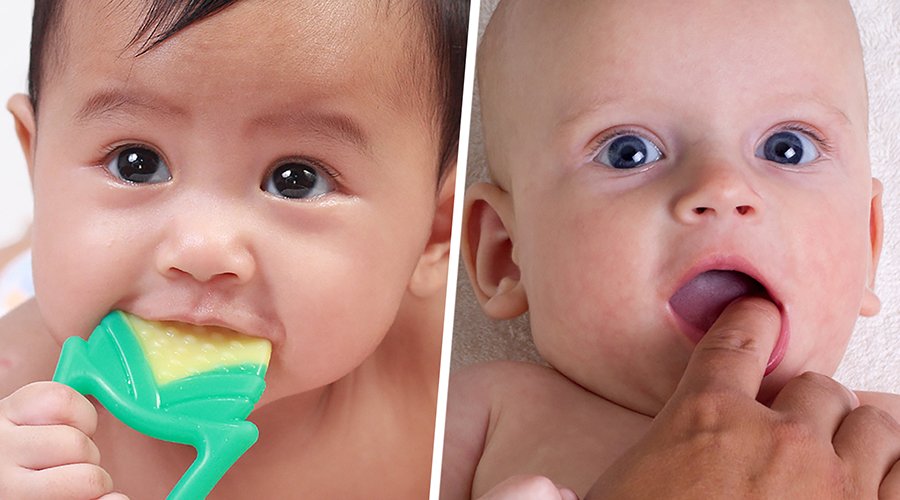
The American Academy of Pediatrics (AAP) recommends culling ways for treating teething hurting, including rubbing infants' gums with a clean finger or providing a teething ring made of firm rubber to chew on. For children with sensory stimulation needs, parents and caregivers should talk to their child'southward wellness care provider about safer options.
On average, children begin teething around 4 to 7 months, and have a total of 20 "baby teeth" by age iii. Co-ordinate to the AAP, occasional symptoms of teething include mild irritability, a depression-level fever, drooling, and an urge to chew something hard.
The Risks of Teething Bracelets, Necklaces and Other Jewelry
Teething jewelry includes necklaces, bracelets, and other jewelry worn past either an adult or child, used by parents and caregivers, and is marketed to salvage an babe'southward teething hurting. It may also exist marketed for employ by people with special needs, such every bit autism or attending deficit hyperactivity disorder, to provide sensory stimulation or redirect chewing on clothes or body parts.
The beads of the jewelry may be made with various materials such as amber, wood, marble, or silicone. Jewelry marketed for teething is non the aforementioned as teething rings or teethers, which are made of hard plastic or rubber and not wearable by an adult or child.
There are serious risks associated with using jewelry marketed for relieving teething pain such as choking, strangulation, injury to the mouth, and infection. Other concerns include potential injury to the mouth or infection if a slice of the jewelry irritates or pierces the child's gums.
Teething Creams and Gels Likewise Have Risks
Parents and caregivers might too look to salvage a teething baby by rubbing numbing medications on the child's gums. Only the U.S. Food and Drug Administration (FDA) warns against using whatever sort of topical medication to care for teething pain in children, including prescription or OTC creams and gels, or homeopathic teething tablets. They offering piffling to no benefit and are associated with serious risk.
Benzocaine — a local coldhearted — is the active ingredient in several OTC oral health care products such equally Anbesol, Baby Orajel, Cepacol, Chloraseptic, Hurricaine, Orabase, Orajel, and Topex. These products should not be used for teething because they can be dangerous and are not useful because they wash out of a infant's rima oris within minutes.
The employ of benzocaine gels, sprays, ointments, solutions, and lozenges for oral fissure and mucilage pain can pb to a serious — and sometimes fatal — condition called methemoglobinemia, in which the oxygen-carrying capacity of ruby-red blood cells is profoundly reduced.
Prescription and OTC benzocaine oral health care drug products are too widely used in adults. Doctors and dentists often utilize sprays containing benzocaine to numb the mucous membranes of the mouth and pharynx or to suppress the gag reflex during medical and surgical procedures, such as transesophageal echocardiograms, endoscopy, intubation, and feeding tube replacements. But benzocaine sprays are not FDA-canonical for these uses.
Talk to your health care professional person almost using benzocaine and other local anesthetics, especially if y'all have heart illness; are elderly; are a smoker; or have breathing problems such as asthma, bronchitis, or emphysema. Those weather condition put you at greater take chances for complications relating to methemoglobinemia.
What You Tin can Do to Ease Teething Pain
If your child'due south gums are bloated and tender, gently rub or massage the gums with your finger, or give your child a teething band made of firm rubber to chew. Make sure the teething ring is not frozen. If the object is too hard, it can hurt your kid's gums. Parents should supervise their children so they don't accidentally asphyxiate on the teething ring.
Parents and caregivers of children with special needs who may require sensory stimulation should talk to their child's health care provider about safer options and treatment. Jewelry marketed for relieving teething pain and to provide sensory stimulation can atomic number 82 to serious injuries, including strangulation and choking.
The FDA continues to closely monitor the use of teething jewelry and other teething pain relief products and is evaluating whether other deportment are necessary to address the risks associated with these products, as office of its commitment to protecting public health – especially when it comes to the health and safety of children.
Consumers and health care professionals should notify the FDA of any agin side furnishings when using drugs and devices the agency regulates, by reporting them online to MedWatch, the FDA's safety data and agin event reporting plan, or past telephone at one-800-FDA-1088.
Source: https://www.fda.gov/consumers/consumer-updates/safely-soothing-teething-pain-and-sensory-needs-babies-and-older-children
0 Response to "What to Put on Babys Gums When Teething"
Post a Comment