Chap 16 a Chave ââå Oã¢ââ¢keeffe and the Masculine Gazeã¢ââ American Art
This work is role of a serial of half-dozen paintings depicting the jack-in-the-pulpit bloom, five of which reside at the National Gallery of Art:
The jack-in-the-pulpit is a common North American herbaceous flowering plant of the Arum family, Arisaema triphyllum (too called A. atrorubens), whose upright spadix, or jack, is enclosed within an elongated, striped spathe. It is closely related to the calla lily, another of O'Keeffe'due south early on floral subjects. A favorite among wildflower enthusiasts, the institute's vernacular name is derived from the resemblance between its spathe arching over its spadix and early hooded church pulpits. It is likewise known as "Indian turnip" because Native Americans cooked and ate its bulbous roots, which they considered a delicacy. Joseph Harned, a botanist, noted that the "jack-in-the-pulpit has been a please to American boys and girls ever since Columbus discovered America."
Joseph E. Harned, Wild Flowers of the Alleghenies (Oakland, MD, 1931), 94.
O'Keeffe has related how her loftier schoolhouse fine art teacher in Madison, Wisconsin, first introduced her to the field of study:
Holding a jack-in-the-pulpit high, she pointed out the strange shapes and variations in color—from the deep, near black earthy violet through all the greens, from the stake whitish dark-green in the flower through the heavy green of the leaves. She held upwardly the purplish hood and showed us the jack inside. I had seen jacks before, but this was the offset time I remember examining a flower. I was a picayune bellyaching at existence interested because I didn't like the teacher.
Georgia O'Keeffe, Georgia O'Keeffe (New York, 1976), northward. p.
The artist has besides described the circumstances that led her to execute the six-painting series at Lake George:
In the wood near ii large spring houses, wild jack-in-the-pulpits grew—both the large dark ones and the small green ones. The year I painted them I had gone to the lake early in March. Remembering the fine art lessons of my high school days, I looked at the jacks with corking interest. I did a fix of six paintings of them. The beginning painting was very realistic. The final one had only the jack from the flower.
Georgia O'Keeffe, Georgia O'Keeffe (New York, 1976), unpaginated text accompanying pl. 41.
Although the sequential numbering of the works' titles implies a serial progression of exploration and refinement that culminated in the sixth version, the actual order of execution is non clear. O'Keeffe and Doris Bry renumbered the series in 1970; the nowadays third painting was originally the second, and the 4th was originally the sixth. Further complicating matters, in that location is no consistent use of Roman and Standard arabic numbers in the paintings' titles and the works vary in size.
The first three paintings in O'Keeffe and Bry's final arrangement are all relatively naturalistic views of a single flower's exterior. The forms are simplified, and the artist fabricated no endeavor to render minute botanical details. The assuming colors are derived from the jack-in-the-pulpit's distinctive imperial-striped spathe (a characteristic that botanists take identified as feature of the fertile plants), and emphasis is placed on the tip of the spadix that protrudes from the protective spathe. Jack-in-the-Pulpit No. one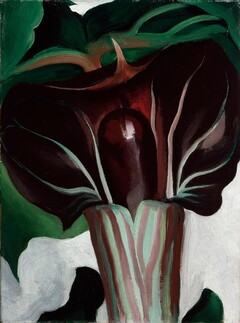 [fig. 1] Georgia O'Keeffe, Jack-in-the-Pulpit No. 1, 1930, oil on sail, private drove, Los Angeles. © Georgia O'Keeffe Museum
The last three paintings in the serial are close-up, lateral views of the spathe'due south interior. In these works, the imagery borders on abstraction.
Margaret Breuning, "Georgia O'Keeffe," New York Evening Post, Jan. 24, 1931.
Neltje Blanchan, Nature's Garden: An Aid to Cognition of Our Wild Flowers and Their Insect Friends (New York, 1904), 367.
Edward Alden Jewell, "Georgia O'Keeffe in an Art Review," New York Times (Feb. 2, 1934). For the record, William Schack, "On Abstruse Painting," Magazine of Fine art 27 (Sept. 1934): 470–475, reproduced and titled the painting "Number 8." 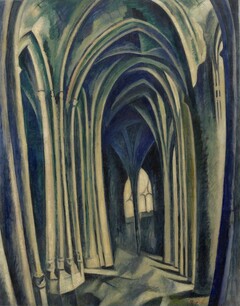 [fig. 2] Robert Delaunay, Saint-Severin No. 3, 1909–1910, oil on canvas, The Solomon R. Guggenheim Museum, New York, Founding Collection. Image: The Solomon R. Guggenheim Foundation / Art Resources, NY
The big magnified representations of flowers that O'Keeffe began to pigment in 1923 are her nigh famous subjects, and the ones with which she is most often associated; every bit early every bit 1929 Miguel Covarrubias caricatured her in the New Yorker as "Our Lady of the Lily" 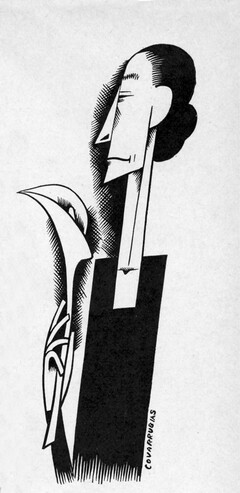 [fig. 3] Miguel Covarrubias, "Our Lady of the Lily," analogy from New Yorker (July six, 1929): 21. © Condé Nast
New Yorker, July vi, 1929.
For a word of some of some of these artists and their images of calla lilies, encounter Charles C. Eldredge, "Calla Moderna: 'Such a Strange Flower,'" in Barbara Buhler Lynes, Georgia O'Keeffe and the Calla Lily in American Fine art, 1860-1940 (Santa Fe, NM, 2002), 18–29.
Lewis Mumford, "O'Keefe [sic] and Matisse," New Republic 50 (March 2, 1927), reprinted in O'Keeffe Exhibition (New York, 1928), and Barbara Buhler Lynes, O'Keeffe, Stieglitz and the Critics, 1916–1929 (Ann Arbor, MI, 1989), 265.
Some early critics, whose outlook was conditioned past the misogynistic symbolist equation between flowers and predatory female sensuality, found O'Keeffe's paintings enticing, sensual, and lewd.
For a summary of these cultural influences, see Bram Dijkstra, "America and Georgia O'Keeffe," in Georgia O'Keeffe: The New York Years, ed. Doris Bry and Nicholas Callaway (New York, 1991), 125–126.
Neltje Blanchan, Nature's Garden: An Aid to Knowledge of Our Wild Flowers and Their Insect Friends (New York, 1904), 368.
Neltje Blanchan, Nature'due south Garden: An Aid to Knowledge of Our Wild Flowers and Their Insect Friends (New York, 1904), 368.
Diverse early on critical responses to O'Keeffe'south floral imagery are discussed in Barbara Buhler Lynes, O'Keeffe, Stieglitz and the Critics, 1916–1929 (Ann Arbor, MI, 1989). Feminist, gender-based fine art historical literature has added another perspective to these issues. Come across, for case, Anna C. Chave, "O'Keeffe and the Masculine Gaze," Art in America 78 (Jan. 1990): 114-125, 177, 179.
For some early viewers, the jack-in-the-pulpit series was distinguished past its phallic imagery. Every bit early every bit December 1930, Arthur Dove wrote to Stieglitz virtually
Quoted in Anne Middleton Wagner, 3 Artists (Three Women): Modernism and the Art of Hesse, Krasner, and O'Keeffe (Berkeley, CA, 1996), seventy.
Sue Davidson Lowe, Stieglitz: A Memoir/Biography (New York, 1983), 310.
Anne Middleton Wagner, Iii Artists (Three Women): Modernism and the Fine art of Hesse, Krasner, and O'Keeffe (Berkeley, CA, 1996), 71.
Henry McBride, "The Georgia O'Keeffe Exhibition," New York Sun, Jan. 24, 1931.
O'Keeffe repeatedly denied that she had intended her flowers to have whatever overt or covert sexual content. She offered an culling—and more than practical—explanation of how she came to paint her "blown-upward flowers":
In the twenties, huge buildings seemed to be going upwards overnight in New York. At that time I saw a painting past Fantin-Latour, a still life of flowers I plant very beautiful, but I realized were I to paint the flowers and so small, no one would look at them because I was unknown. So I thought I'll make them await big like the huge buildings going upwards. People will exist startled; they'll have to look at them—and they did.
Katherine Kuh, The Artist'south Phonation: Talks with Seventeen Artists (New York, 1962), 190–191; quoted in Henry Geldzahler, American Painting in the Twentieth Century (New York, 1965), 131–132.
On another occasion she offered a like account of what led her to paint flowers, and direct refuted the critics: "Well—I made you take time to look at what I saw and when you took time to actually observe my bloom you hung all your own associations with flowers on my blossom and you write about my flower as if I think and see what you think and run into of the flower—and I don't."
Georgia O'Keeffe, "About Myself," in Georgia O'Keeffe: Exhibition of Oils and Pastels (New York, 1939), due north. p. The text is reproduced in Georgia O'Keeffe, Georgia O'Keeffe (New York, 1976), n. p.
The imagery in O'Keeffe's floral subjects is indeed suggestive, and in the 1920s and 1930s—the era of Sigmund Freud, D. H. Lawrence, and Sherwood Anderson, and the superlative of the women's suffrage movement—they were probable to exist interpreted every bit such. From the perspective of plant symbolism, the jack-in-the-pulpit, and other of O'Keeffe'due south floral subjects, had potent sexual connotations; one early on 20th-century writer fifty-fifty commented: "Female botanizing classes pounce upon it equally they would upon a pious immature chaplain."
Neltje Blanchan, Nature's Garden: An Help to Noesis of Our Wild Flowers and Their Insect Friends (New York, 1904), 367. For a word of blossom symbolism in O'Keeffe'southward paintings, run into Charles C. Eldredge, Georgia O'Keeffe (New York, 1991), 82–90.
Charles C. Eldredge, Georgia O'Keeffe (New York, 1991), 90.
Robert Torchia
September 29, 2016
Source: https://www.nga.gov/collection/art-object-page.70180.html
0 Response to "Chap 16 a Chave ââå Oã¢ââ¢keeffe and the Masculine Gazeã¢ââ American Art"
Post a Comment